Map the roles, including overlapping ones
Record who owns the land, standing timber, machinery and stock at each stage. One company may own woodland, buy standing timber and carry out harvesting. A broad business label may not describe all these roles adequately.
Include secondary activities, work on other people’s sites and subcontracting in the insurance enquiry. France Assureurs explains why declared activities matter for liability cover. Ask the insurer to confirm how the actual operations described in your dossier are reflected in its proposal.
Allocate the questions to the right activity
| Role | Exposure to examine | Question to ask |
|---|---|---|
| Woodland owner | Liability and damage to tree stands | Which parcels and events are included? |
| Forestry contractor | Work, equipment and entrusted property | Are the actual tasks and machines declared? |
| Timber merchant | Purchased timber, storage and transit | When does the timber enter the cover? |
| Sawmill | Buildings, equipment, stock and downtime | Which dependencies could stop production? |
This is a discussion checklist, not a statement that every policy automatically includes these protections. Confirm the insured entity and each relevant location.
Woodland liability and tree losses are separate
Liability insurance addresses harm to third parties within the policy terms. It does not mean your own trees will be paid for after a fire or storm. The CNPF forest insurance guide distinguishes liability from property damage.
Ask how each French woodland parcel is identified, which values are used and whether associated costs are included. If you undertake work yourself, describe it. The answer needs to address those operations as well as ownership. Keep written confirmation with the parcel schedule and update the discussion when your activities change.

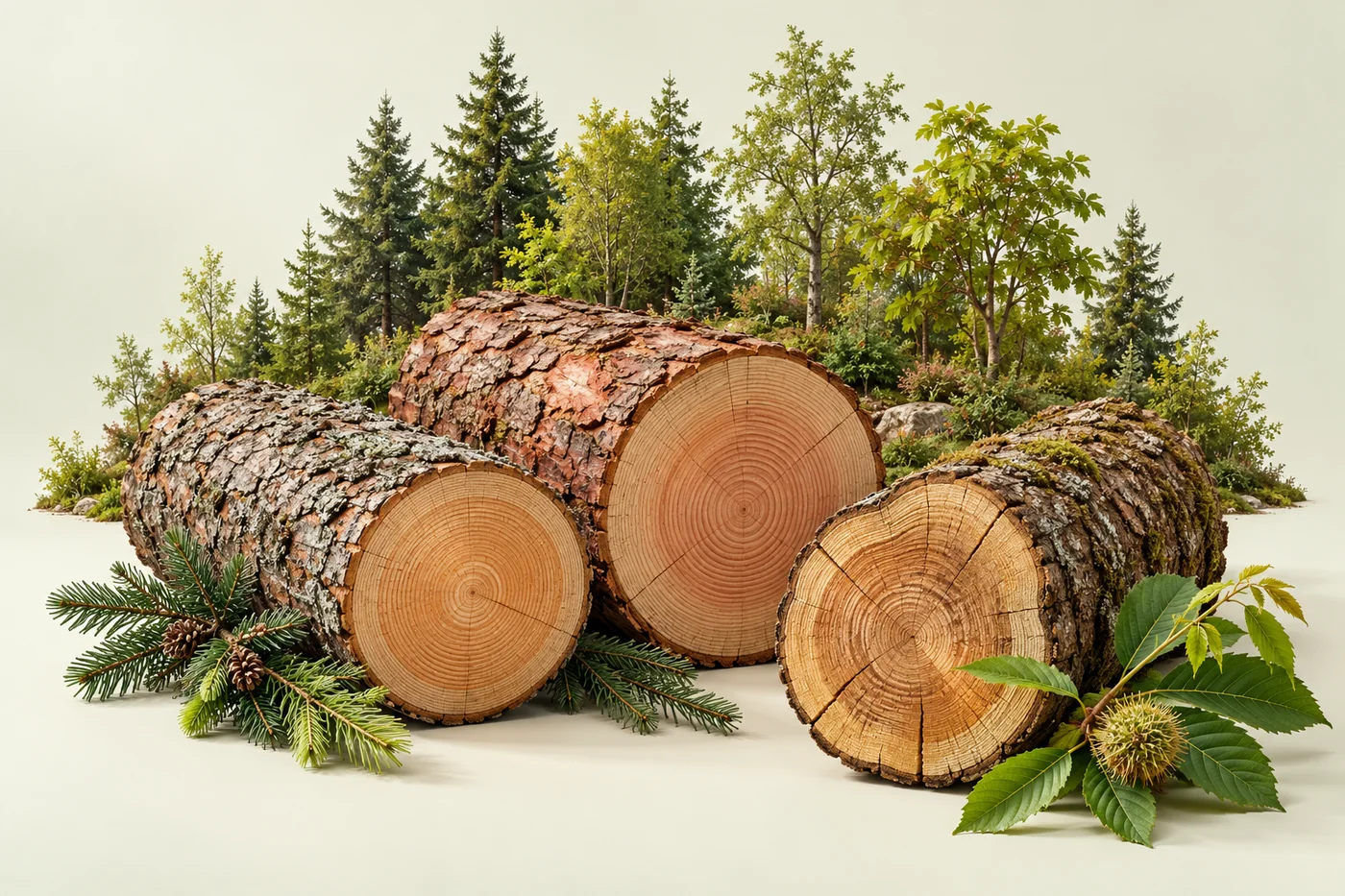
The landscape gives context; value depends on the selected land, its trees and access conditions.
Editorial illustration · not a depiction of an analysed propertyFor a mill, examine downtime as well as machine value
Replacing a component does not always restore production immediately. Work with suppliers to sketch a realistic sequence: assessment, ordering, delivery, installation, commissioning and recovery of normal output. Identify stages that cannot happen at the same time. This creates a useful basis for discussing the length of interruption cover.
In the standard cover described by France Assureurs on business interruption, interruption must follow insured physical damage. Confirm the trigger, indemnity period, deductible and calculation basis. A fall in customer orders alone is not that situation.
Test the handovers between policies
Consider a hypothetical timber flow: standing trees are purchased, a contractor harvests them, logs are held at a third-party yard and a haulier takes them to a mill. At each stage, record the owner, custodian, location and policy expected to respond. Send uncertain cells to the insurer.
The France Assureurs business risk checklist separates equipment, transport and liability exposures. Use it as a starting point, then seek confirmation for your actual operations. A partner’s insurance certificate does not describe the protection provided by your own policy.
Compare offers against concrete scenarios
Choose two plausible loss scenarios and ask how each offer would respond. For example, stock damaged by fire and a critical production line stopping after an insured event. Compare covered activities and assets, limits, deductibles, waiting periods, exclusions and prevention requirements. Record the answers before focusing on the annual premium.
An indicative woodland assessment can inform your asset review. It is neither an insurance certificate nor a valuation automatically accepted by an insurer. Insured amounts and valuation bases need to be agreed in the insurance documentation, alongside the activities they relate to.
COMMON QUESTIONS
A few things to clear up.
Will woodland owner insurance cover a sawmill in France?
Do not assume it does. A mill has separate premises, stock, equipment and operations to disclose. Confirm the cover for each legal entity, site and role.
Does business interruption insurance cover every revenue decline?
No. Examine the contractual trigger. Standard cover connected to insured physical damage does not automatically respond to a commercial downturn without that damage.
Why not simply choose the lowest annual premium?
Premiums may correspond to different activities, limits, deductibles and exclusions. First compare policies using the same dossier and the same loss scenarios.
Sources and dates
Figures retain their reference year. Worked examples are educational; property-specific amounts require verification.
- France Assureurs — Commerçants, artisans : l’assurance de vos responsabilités professionnellesConsulté le 19/10/2026
- France Assureurs — L’assurance des pertes d’exploitation de l’entreprise2024-05-27
- France Assureurs — Les risques et les assurances de l’entrepriseConsulté le 19/10/2026
- CNPF Nouvelle-Aquitaine — L’assurance en forêtConsulté le 19/10/2026
Sources accessed 19 October 2026. Independent sources; no partnership implied.
This guide provides documentary context. For a binding decision, have field, legal or insurance issues checked by the relevant professional.